Stay Updated
Receive news, analysis and event invitations directly to your inbox.

The May 23-25 Ag/Sum Agritech Summit in Tokyo brought together start-ups, agtech consulting and investors from overseas with start-ups, food and agri-industrial companies, IT companies, banks, government representatives from Japan.
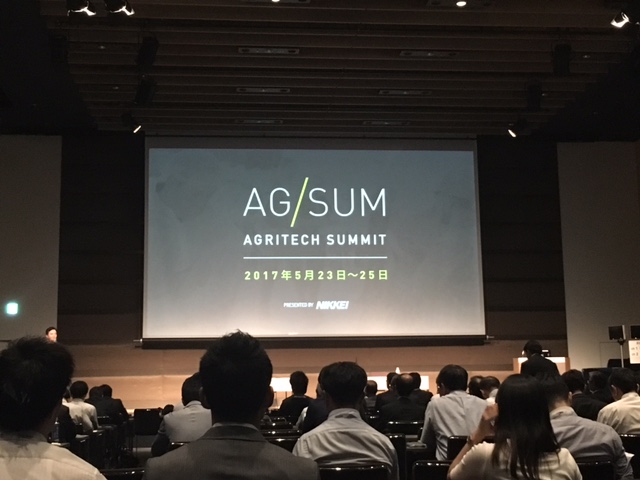
This was the third start-up event organized by Nikkei, and this time it focused on agtech and “the ways that disruptive technology is fusing with agriculture to share our future.” The event drew hundreds of participants– large symposium sessions, workshops and an innovation stage, all going at the same time for three days.
The strength was that the event brought well-known international agtech players to Japan, many of whom had never been to Japan before and did not know much yet about the Japan agtech or food innovation market.
Considering Japan’s potential as both a funder as well as a source of global food and agtech innovation, this event was an important opportunity for the audience (80% Japanese by our estimate) to hear directly from some of these industry leaders. Key US and EU participants included AgFunder, Rabobank Start-up Innovation, RWA/ Agrotech Innovation Lab. Speakers and exhibitors also attended from Israel, India, Singapore, Vietnam and Australia.
The event provided some insights on key topics of interest to our clients and partners here in Japan:
We’ll outline some of our impressions below.
Where are we headed?
The event was a showcase for many of the hot topics in the industry. Several VC and investment advisors gave their ideas on the key areas to watch in the next 4-5 years.
It was interesting to note that “the future” is not defined as a specific type of product or technology, but as the trend of current technologies adapting to new markets and social trends, and being applied to critical environmental issues.
Foodtech: Alternative proteins, molecular biology and the Japan market
The diversity of alternative proteins and food ingredients was striking and particularly of interest to many of the Japanese participants. These included insect protein start-ups like Ynsect and Go-Terra. While they admitted that marketing insect protein for human food products still has challenges, insect protein is intriguing to the aquaculture industry. Already nearly 50% of the seafood consumed in the world is from aquaculture and it is an important industry for Japan. Current sources of protein for fish meal, such as meal processed from wild catch of smaller fish, are not a sustainable source of protein for a growing industry. This makes insect protein an attractive idea.
In addition, companies ljke Miraculex and MycoTechnology offer natural biotechnologies that can reduce sugar content and Algama offers high protein microalgae. For a country like Japan, where food tech innovation is already strong and where an aging population is inspiring food manufacturers to develop new products that appeal to this demographic’s health needs, these food technologies appeared to be particularly interesting to Japanese attendees.
Investment Strategies: Where is Japan now in agtech investing?
Global ag investment watchers expressed interest in seeing more seed and Series A investors in agtech. It was mentioned that many of the larger, more mature (and therefore lower risk) companies have already been fully invested.
However, Japanese investors, including the large trading conglomerates and banks who attended the conference, are infamous for their low tolerance for risk. The traditional Japanese investors also have few experienced funds or teams looking at small scale seed investing in agtech.
Japanese investors were criticized by some for their lack of engagement in early stage, seed, incubation, acceleration ventures. Two of the start-up VCs we talked to dismissed Japanese investors as partners because of their image that Japanese investors are not interested in fostering innovation, only in safe late-stage investments.
This image may not be entirely correct, but it impacts the development of potentially interesting partnerships between Japanese investors and overseas partners.
Nevertheless, investors worldwide now are looking for evidence that agtech investing can yield the kind of returns they are looking for. AgFunder mentioned that the agtech industry now needs to see some successful EXITS of first round investors. Without some successful, profitable exits it will become harder to attract new investors. And without more successful exits, the 1 billion valuation of The Climate Corporation (acquired by Monsanto) will likely continue to be an exception in the agtech industry.
What we’d love to see at the future Agtech Summits in Japan
The focus on the event for the foreign players was seed investments, innovation and start-ups. However, Japanese attendees, especially ones from large corporations tend to be more familiar with medium and large size investment and they are still nervous about supporting early stage projects. Other large Japanese companies, some of whom presented in workshops, are mostly focusing on internal innovation (Kubota, Fujitsu etc).
We would love to see more chances to connect these worlds.
Ag and food technologies are not limited to one market or language, but they do face differences in agricultural industry issues and investor expectations in different countries. We look forward to more agtech summits in Japan that allow even deeper comparisons and discussions about Japanese models and challenges in agtech versus lessons of success from overseas markets.

In this final installment of the cellular agriculture series, Meros analyst Sachika Onaka turns to cultivated seafood and other emerging applications of cellular agriculture, including cultivated fat and cultivated chocolate. In earlier articles, we explored the development of the cultivated meat industry in Japan, focusing on startups and partnerships that are shaping the sector. Cultivated […]

Meros co-founder Lucia Vancura kicked off January at the Tufts University Center for Cellular Agriculture (TUCCA) Cellular Agriculture Innovation Day in Boston, eager to understand how investors were thinking about the cellular agriculture sector for 2025 and if it was really as pessimistic as it seemed. In this installment, we take a look at the […]
With the new year underway, we continue our snapshot series on Japan’s cultivated meat industry. In this installment, Meros analyst Sachika Onaka focuses on the overseas and Japanese regulatory landscape and reflect on key regulatory developments in 2024. Overseas regulatory landscape Singapore is the world leader in terms of implementing cultivated meat regulation. In 2020, […]
Receive news, analysis and event invitations directly to your inbox.